
Purble Place Release Date & History
When it came out, who made it, why Microsoft removed it and how a forgotten kids’ game became a Gen-Z icon.
Purble Place was released worldwide on 30 January 2007, bundled with Windows Vista. It was developed in 2005 by Oberon Media for Microsoft, with Jane Jensen as lead developer. It shipped again with Windows 7 in 2009, then Microsoft removed it from Windows 8 in 2012 and it has never returned to Windows 10 or 11.
Purble Place turned up on hundreds of millions of computers, and for nearly twenty years almost nobody knew who made it. This page covers the full history: the exact release date, the team behind it, why Microsoft pulled it from Windows, and how a forgotten children’s game became a Gen-Z obsession with tens of millions of views online. If you’ve ever wondered when Purble Place came out or why it vanished, here’s the whole story.
When Did Purble Place Come Out?
Purble Place was released worldwide on 30 January 2007, the same day Windows Vista launched to the public. Every retail copy of Vista included it.
But that’s the public release date, not the game’s first appearance. Purble Place actually showed up earlier, in September 2005, inside the Windows Vista build 5219 community technical preview a pre-release test version of the operating system. It arrived alongside two other new Vista games, Chess Titans and Mahjong Titans.
So there are three dates worth knowing, and they explain most of the confusion online:
2005
The year the game was developed and first appeared in a Vista preview build.
30 Jan 2007
The official worldwide release with Windows Vista.
Oct 2009
When it shipped again with Windows 7 how most people met it.
Purble Place release date Timeline (2005–2026)
Here’s the full history in one place.
Who Made Purble Place?
Purble Place was developed by Oberon Media a casual games studio that no longer exists under contract to Microsoft. The lead developer was Jane Jensen, with Cara Ely producing and programmers Brendan Walker, Dan Thompson, and Tam Armstrong on the team. The game’s audio was created by Robert Holmes.
Lead developer | Jane Jensen |
|---|---|
Producer | Cara Ely |
Programming | Brendan Walker · Dan Thompson · Tam Armstrong |
Audio | Robert Holmes |
Studio | Oberon Media |
Publisher | Microsoft |
That lead developer credit is the genuinely surprising part. Jane Jensen isn’t a casual-games unknown she’s a celebrated adventure game designer who worked at Sierra On-Line, co-designed King’s Quest VI, and created the acclaimed Gabriel Knight series. The person behind one of gaming’s most respected mystery franchises also made the pastel cake game bundled with Windows.
Here’s the strange part: for almost twenty years, nobody knew any of this. The only credit in the game was a plain “Oberon Games” line tucked into the help menu. Despite being installed on hundreds of millions of machines worldwide, the people who actually built Purble Place stayed anonymous and had no idea the game had developed a following.
When The Guardian tracked Jensen down in 2024, her reaction was refreshingly human. Asked about the game, she admitted she’d needed to look up screenshots to “even remind myself” what it looked like. She’s made a lot of games. Today she writes romance novels and lives in Washington state with Robert Holmes her husband, and the man who wrote the game’s music along with a blind bulldog named, fittingly, Oberon.
How Purble Place Was Made
The development story is more constrained than the game’s cheerful surface suggests.
Microsoft approached Oberon Media in 2005 to refresh the games bundled with Windows, and asked for one original children’s title to sit alongside the updated classics. The brief was essentially “make a Solitaire for kids.” Oberon, meanwhile, had bigger fish frying Microsoft had also booked the studio to build launch titles for Xbox Live Arcade, and internally Purble Place was treated as the smaller side project.
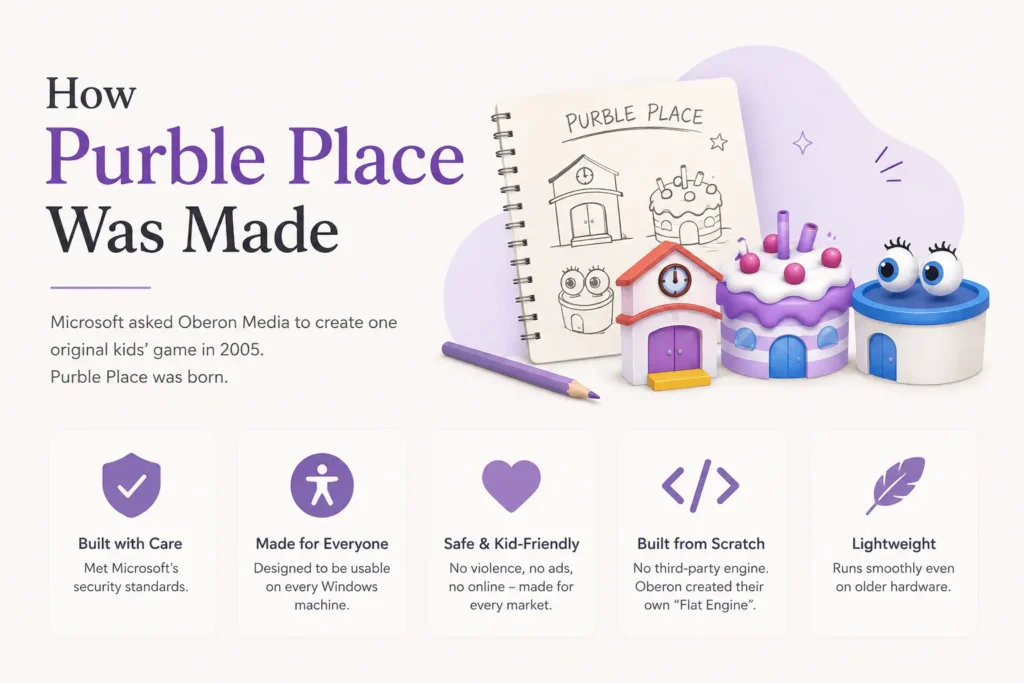
The team had under a year to deliver, and the constraints were unusually heavy for a kids’ game:
Those restrictions shaped the finished game more than any design document. No ads, no accounts, no internet connection, no way to spend money the exact qualities players now describe as the game’s charm were originally compliance requirements.
Why Was Purble Place Removed from Windows?
Microsoft removed Purble Place along with every other built-in game when Windows 8 launched in 2012. It has never come back. Windows 10 and Windows 11 don’t include it either.
There was no scandal and no single dramatic decision. It came down to a shift in how Microsoft delivered software:
Microsoft moved games to the Store.
Windows 8 introduced the Microsoft Store and a new app model. Instead of shipping games inside the operating system, Microsoft moved them out as downloadable apps it could update and monetise separately. Solitaire and Minesweeper made that jump and returned as Store apps with ads and optional purchases.
Purble Place didn’t make the jump.
It was a classic Win32 desktop game, tightly wired into Windows’ own system components and older graphics libraries. Bringing it to the new app model would have meant a full rewrite and Microsoft chose not to invest in that for a legacy children’s title.
Windows’ priorities changed.
Later versions leaned toward productivity, cloud services, and a modern interface. Bundled entertainment simply stopped being part of what Windows was for.
Oberon Media was gone.
The studio that built it no longer exists, so there was no partner pushing to keep it alive.
So, Purble Place wasn’t cancelled so much as left behind a casualty of Windows changing how it distributes software, not a decision about the game itself.
How Old Is Purble Place?
years old in 2026, counting from its January 2007 public release and around 21 years counting from when development started in 2005.
To put that in context: it’s been absent from Windows longer than it was ever included. The game shipped with Windows for roughly five years (2007–2012) and has been missing for fourteen. Most of the people posting about it online today are remembering a game that was removed before they finished school.
How a Forgotten Game Became a Gen-Z Icon
Purble Place should have quietly disappeared. Instead it became one of the most fondly remembered games of its era, and the revival has a few clear causes.
The art style came back into fashion.
Purble Place is a textbook example of Frutiger Aero the glossy, pastel, bubble-shaped aesthetic that defined mid-2000s technology and Windows Vista in particular. That look has had a major revival online, and Purble Place is one of its most recognisable artefacts.
It was genuinely well designed.
Underneath the cute exterior sit three real puzzles: a memory game, a reaction game, and a Mastermind-style logic puzzle with 3,125 possible solutions on its hardest setting. Adults kept playing because the game kept being interesting.
It had no ads and no catch.
No microtransactions, no sign-ups, no internet connection. For a generation now surrounded by monetised apps, a completely self-contained game feels almost radical in hindsight.
It was everywhere, and it was free.
Pre-installed on Vista and Windows 7, it needed no purchase, no account, and no permission from a parent. School labs, family desktops, a relative’s laptop the same purple game was on all of them. Shared experiences make the strongest nostalgia.
views across TikTok and YouTube the scale of the revival is what prompted The Guardian to investigate in the first place. The creators had no idea any of it was happening.
Can You Still Play Purble Place Today?
Yes the game is easier to reach now than at any point since 2012. You have three options:
Once you’re in, our guides go deeper on each mini-game: the Comfy Cakes cake game guide » and the Purble Place characters, Purble Shop & Purble Pairs guide .
Purble Place History FAQs
Final Thoughts
Purble Place is a strange little piece of computing history: a game built under tight deadlines as a side project, shipped to hundreds of millions of people, quietly deleted five years later, and then resurrected by a generation who found it again as adults. The people who made it didn’t even know it had fans until a journalist called. If that story makes you want to open it up again, the browser version is a click away and honestly, playing Purble Shop on Advanced with twenty years of hindsight is a strange kind of delight.